Connections at Hirschman's
Hi! I'm so glad you visited my artwork and are interested in learning what's behind it.
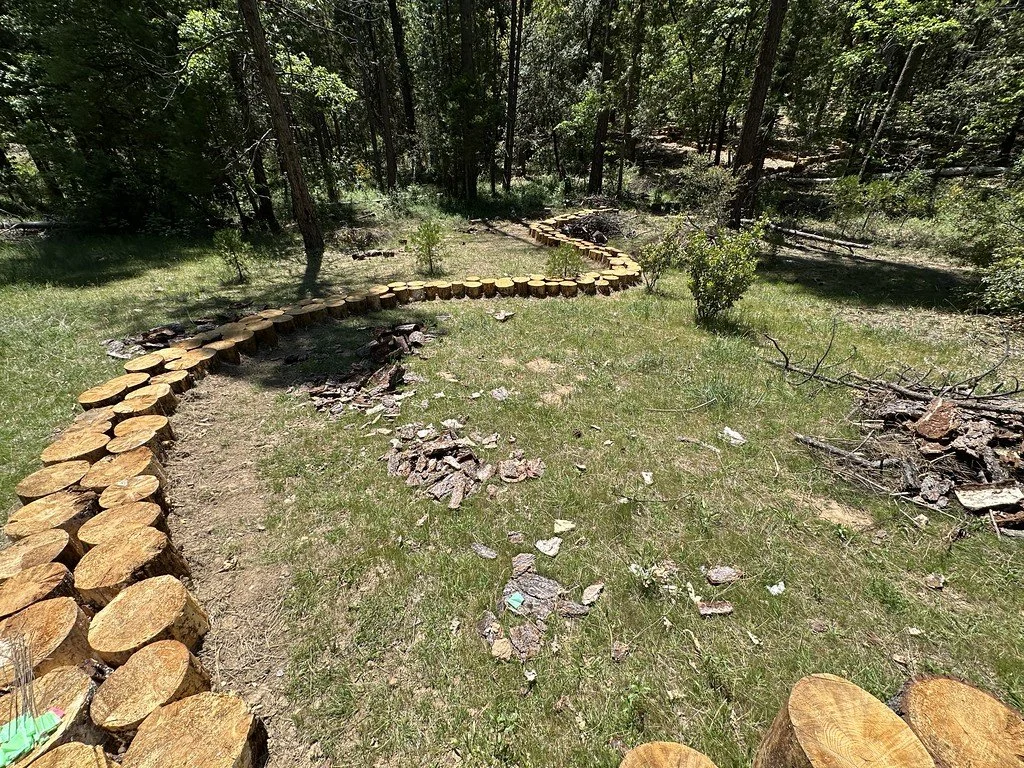
I first walked through that forest stand when invited to contribute an artwork to the Bear Yuba Land Trust's Art on Trails event in 2023. In my process of developing a concept for an installation I look for what is abundant that can serve as the material for the artwork. At the installation site I was immediately struck by the number of fallen trees and standing dead trees (and dead trees partially fallen but held up by other trees). The project was too ambitious for that event, but I held on to it and when invited again to participate, I had a concept to start from and much more time to do the work. I was initially going to cut 8 foot logs and have the trail be a collection of straight lines overlapping to make the feeling of curves, but I let that go after really considering the effort that would require and how messy the final result might look. I recalled a smaller quick artwork I had made several years prior using my neighbors pile of cut log rounds and saw that using rounds would allow me to make graceful curves and would also allow people to walk on it.
The inspiration behind the design comes from learning about the emerging understanding of the tremendous role fungi play in a forest. Science has long known that plants form symbiotic relationships with fungi, with the plant sharing the sugars it forms through photosynthesis and receiving nutrients and water in return. However, the extent of this relationship is becoming more clear, and it is astonishing.
While one generally might picture a mushroom when hearing the word “fungus,” that is simply the portion of a fungus that is most visible (and delicious) to us. A mushroom is the reproductive part of the fungus, getting above ground to spread spores. The majority of a fungus is generally happening below ground and is more distributed than a singular (seeming) mushroom. A fungus is essentially a web of threads collectively called the “mycelium” that are actively decomposing organic matter. While there are many critters that eat dead matter, at the macro (visible) level, fungi are the ultimate decomposers, breaking organic matter down to its constituent parts, releasing minerals into the soil. The smallest part of a fungus is the “hyphae,” which are filaments 20-50 times smaller than a human hair. These hyphae can infiltrate the smallest nooks and crannies. The mycelial web enables the fungus to transport nutrients and chemical signals across its length. The size of the underground mycelial web of a particular fungus can vary widely; however, consider that the largest single individual organism on earth is a fungus which spans 3.5 square miles.
We’ve traditionally understood that plants use their roots to extract water and nutrients from the soil. Roots are covered in fine root hairs which increase the surface area of the main root, allowing them to touch more soil. However, a fungus hyphae can be 10-15 times smaller than a plant’s root hairs, and when a fungus is working with a plant, the absorptive capacity of the plant can be up to 100,000 times greater than the root alone. Add to this that a plant working with a fungus now has access to everything that the fungus is contacting across its length. And fungi are interacting with other fungi of their species and other species of fungi. An astonishing picture emerges of a system vastly more complex than we have previously known.
In forests, the mycelium connects the roots of different trees and plants, creating what is called the mycorrhizal network. This network allows trees to transfer water, nutrients, and even chemical signals to one another. Older, established "hub" or "mother" trees can support younger saplings—especially those growing in shade—by sending them nutrients and sugars through the network. Research suggests that trees can also send distress signals via the network, prompting neighboring trees to bolster their defenses against threats like insect attacks.
Fungi are essential to the well-being of a forest, enabling effective and efficient nutrient cycling, supporting the establishment of seedlings, particularly after disturbances like fire or logging, and enhancing ecosystem resilience and stability by enabling the sharing of resources across the system.
Wow!
I liken the fungus/forest relationship to the one we people have with our gut bacteria. Only in recent years has science started to recognize how important this unseen symbiosis is to our health, and how pervasive its impact is on the systems in our bodies.
In my installation at Hirschman’s the logs are forming a trail that end at several “nodes.” This is my version of the fungus connecting different parts of a forest. I plan to create more installations to work with these nodes. I look forward to the years that come when the forest section I worked in can re-wild- leaves and branches falling and covering the disturbances to the ground, the logs sinking further into and bonding with the soil through fungus (while repositioning logs I sometimes had to peel the log off the ground due to the fungal connection already happening), vines and plants growing up between the log gaps. The log trail will be the way to access the forest section.
To learn more check out:
- Entangled Life: How Fungi Make Our Worlds, Change Our Minds and Shape Our Futures