
Creating beauty that washes away with the tide is a practice in presence, impermanence, and the joy of making something for its own sake.
About Andres Amador
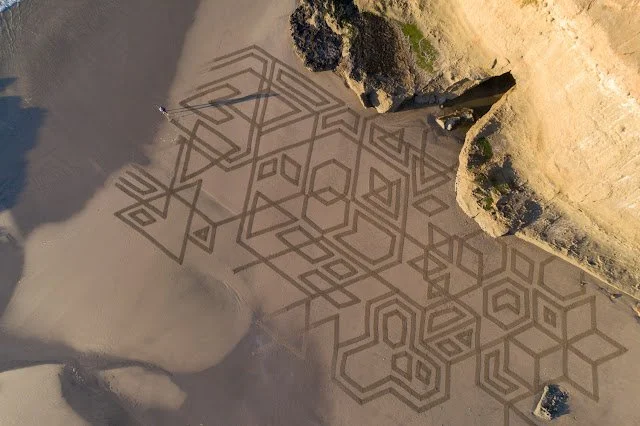
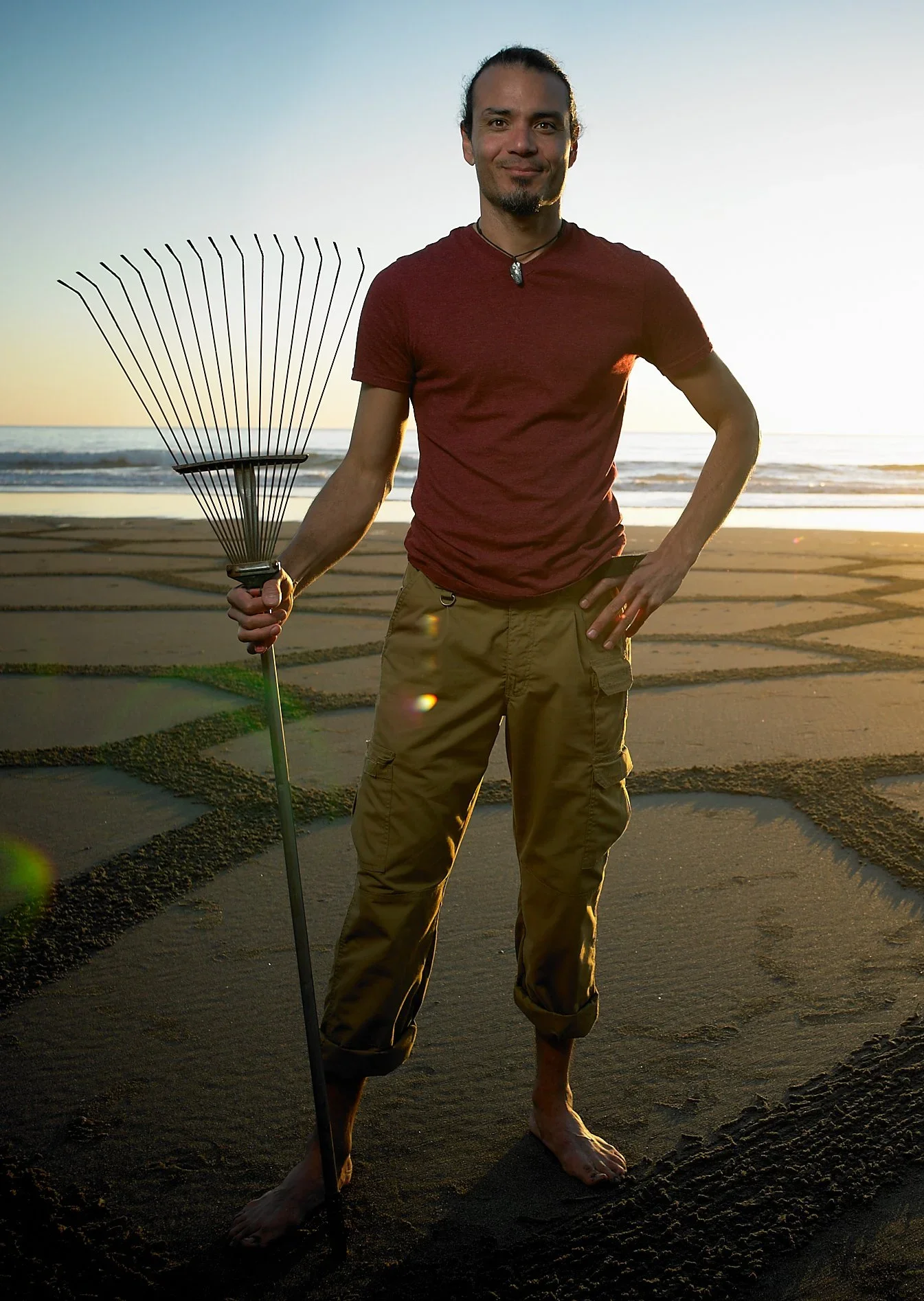
I call myself an earthscape artist—I create large-scale temporary art using natural materials that eventually dissolve back into the landscape. Best known for intricate geometric and organic designs raked into beach sand at low tide, I also work with clay, straw, and other found materials across various terrains.
What began as personal artistic exploration nearly 25 years ago has evolved into a practice that spans commissioned work for brands and organizations worldwide, and facilitated experiences where groups create collaborative art in nature.
What Drives This Work
The joy of creation itself. Working barefoot at the beach, moving my body with the rake, making beauty that exists for just a few hours before the tide returns—there's something perfectly right about art that doesn't need to be preserved.
The Path Here
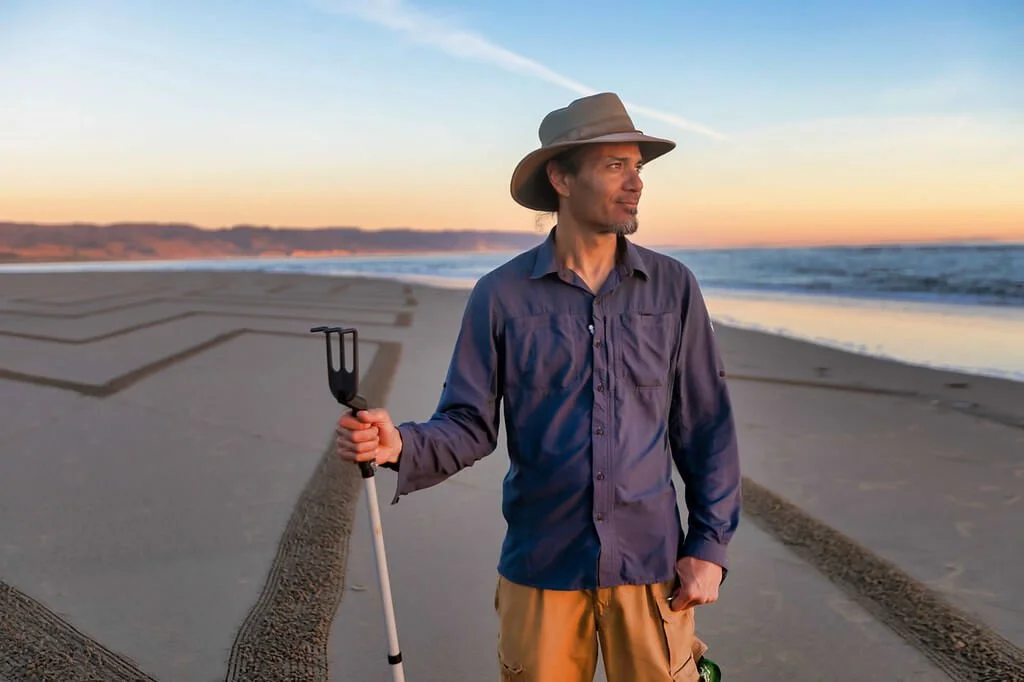
I'm a third-generation San Franciscan who grew up in the Mission District surrounded by towering murals that showed me art's power to transform public spaces. After studying Environmental Sciences at UC Davis and serving in the Peace Corps in Ecuador developing conservation education, I returned to San Francisco during the first dot-com boom.
The arts scene was exploding. I gave myself permission to fully engage my creativity—something my right-brain personality had never previously allowed. When the beach art concept came to me, it completely reoriented my world. Everything else fell away.
Now I live in the Sierra Nevada foothills with my family, homeschooling my son and spending summers canyoning in local rivers. I still travel to create commissioned work on beaches around the world, but I keep coming back to the gift of guiding others through creative experiences in nature.
Bring This Work Into Your World
Fine Art Prints – Bring the beauty home
Workshops – Connect to your creativity and create larger than yourself
Team Experiences – Collaborative art for groups and organizations
Commissions – Custom large-scale art for your message or moment
Your Questions, Answered
-
Earthscape art (also called land art, environmental art, or beach art) uses natural materials to create artwork directly in the landscape. My beach murals—sometimes called playa paintings or sand drawings—are created by raking designs into wet sand at low tide, where the color difference between raked and undisturbed sand reveals the pattern.
-
For the geometric designs I use a rope as a compass. the rest is geometry in action- and its perfection is a thing of beauty to participate in. For the organic designs, the pattern is 'grown' using principles of growth. For them, perfection is a state of such complete integration that the entire artwork seems to 'exist' as its own entity. The best unintended compliments I have received were from folks thinking a pattern was naturally occurring.
-
I have never officially measured my pieces. But judging from the size of people in them, they can go up to 300' or larger (90,000 sqft.). Generally, I go as large as possible given tide and beach constraints. How long does it take? I usually give myself about 2 hours of working in the space of the low tide.
-
I can be a stickler for getting something the way I think I want it- which is more goal-focused. But ultimately, when it is finished, I let it go. For me the energy and draw is around the act of creation. Even on days when everything goes wrong and there's no way a 'finished' piece can result (rogue waves wash away a huge section prematurely, discovering the sand has washed away leaving only pebbles, a parade of dog walkers shows up (yes all these have happened!)) I still appreciate the act of being at the beach doing the art.
-
I've worked on beaches across nearly every continent, though most of my work happens in Northern California.